
Scamwatch has all the latest information about scams, what’s happening and how to protect yourself. Here are some of the most common scams to be aware of!
Skip to contentSkip to footerSkip to chat
Bupa is aware of scammers impersonating Bupa recruitment personnel and offering non-existent job opportunities, targeting individuals via non-Bupa email accounts such as gmail.com.
All official Bupa email correspondence originates from a valid Bupa email address only i.e. @bupa.com.au or @bupa.co.nz.
If you have interacted with this email, please contact us at scams@bupa.com.au for assistance.
Our digital lives are interconnected, so if you fall victim to a scam, your digital accounts and online data may become compromised.
Scammers like to induce action by playing on our emotions – such as fear, desire for information or excitement. They also tend to impersonate well-known and trusted brands to seem even more convincing. We know that scammers will use any reason to trick people into revealing more details than they should, for example, COVID-19, Black Friday sales, crypto investments, Amazon sale days etc.
Always remember, if it’s too good to be true, it most likely is! Take some time to verify it before taking action. Awareness of scams is one of the best methods to prevent becoming a victim and helping others!
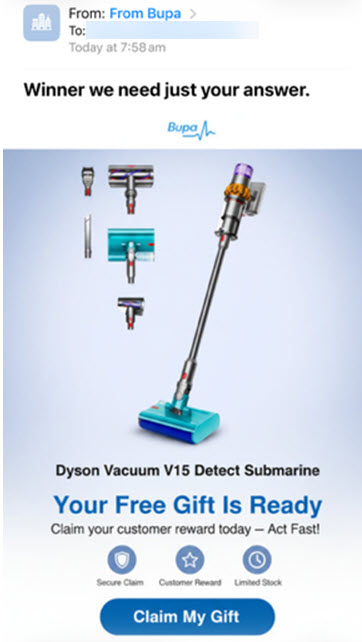
Bupa is aware of scam emails suggesting recipients can claim a free gift such as a Dyson vacuum cleaner. These emails originate from a non-Bupa email address, include an outdated Bupa logo, and little to no context. Other variants of this email may be in circulation also.
If you have received or interacted with this email, or provided any information, please let us know via Report a Scam.
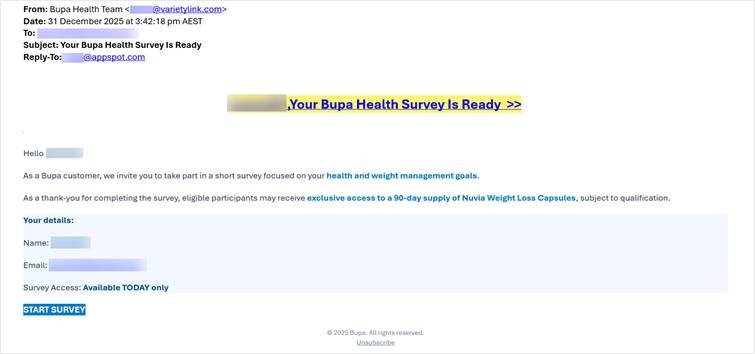
Bupa is aware of an email scam in circulation inviting recipients to participate in a fake Bupa health survey. Indicators the email is not legitimate include:
This email is not from Bupa - do not click the link, reply, or provide any information. If you have interacted with this email, please contact us at scams@bupa.com.au for assistance.
Note: Emails received may vary from the example provided.
The Australian Communications and Media Authority (ACMA) is warning Australians about a new scam where criminals impersonate HotDoc, a medical appointment booking service. Fake messages are being sent about Medicare refunds or overcharges.
These text messages and emails include a link to a fake website that appears legitimate but is designed to steal your personal or banking details.
Avoid clicking on links in messages unless you are certain they are genuine. When in doubt, go directly to the HotDoc App or HotDoc website.
Bupa has become aware of scam calls being made to some of our members (and previous members), where the caller ID may appear as one of Bupa’s phone numbers: (03) 9487 6400 or (03) 9454 8814.
We understand that these calls are generally including questions about claims or treatment details, discussing that these claims may be re-assessed and requesting bank account details.
Please be aware that these calls are not from Bupa, and the number is being spoofed (this means that the caller is masking their real phone number to make it appear like another number) to make it look like the call is coming from Bupa.
What to do:
We’ll confirm whether the call was legitimate and either connect you with the appropriate Bupa team, or—if it was suspicious—guide you through steps to help keep your account safe and secure.
The Australian Communications and Media Authority (ACMA) is warning Australians about a new scam where criminals impersonate HotDoc, a medical appointment booking service. Fake messages are being sent about Medicare refunds or overcharges.
These text messages and emails include a link to a fake website that appears legitimate but is designed to steal your personal or banking details.
Avoid clicking on links in messages unless you are certain they are genuine. When in doubt, go directly to the HotDoc App or HotDoc website.